
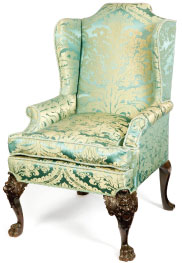
The chair is arguably the simplest and most useful piece of furniture. Its form has varied widely throughout history and cultures; sometimes it is strikingly basic in its simplicity and sometimes it can be a tribute to the craftsmanship of the artisan furniture maker and upholsterer, featuring decorative elements such as elaborate carving and gilding. For instance, throughout the long Georgian era (1714-1837), various forms of seating such as dining chairs, library chairs, carvers and sofas underwent distinct evolutions of form and fashion as tastes in Britain and Ireland changed.
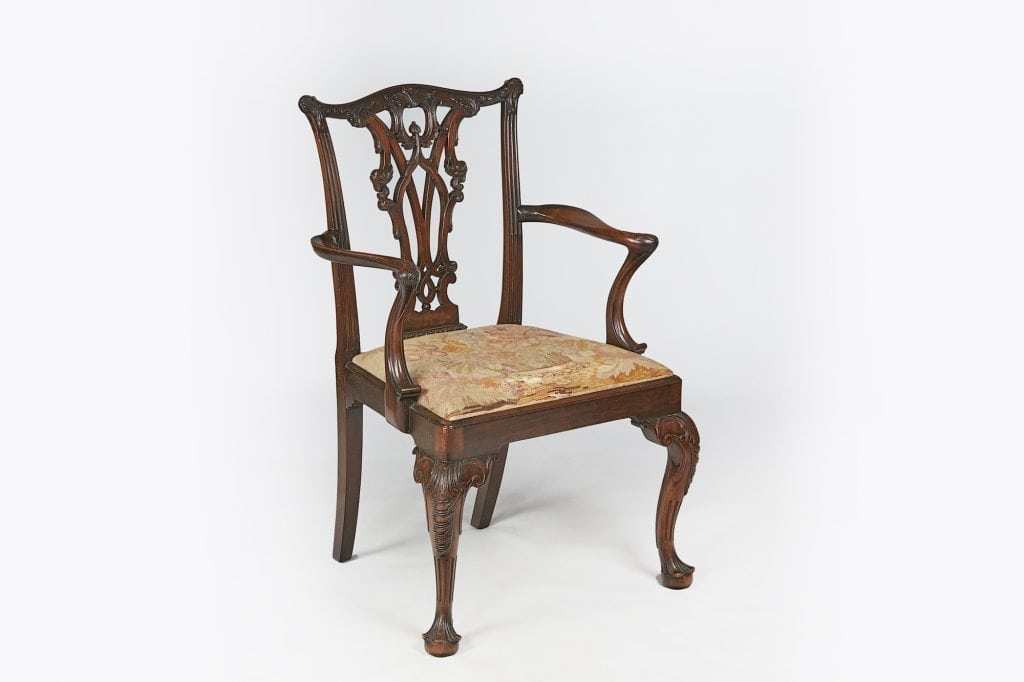
The early Georgian period drew on Palladian classicism with furniture (notably that of William Kent) retaining a Baroque boldness in terms of scale and carving. Detailed carving of cabriole legs reached a high point in the 1730-40s. Towards mid-century, a straight, square leg became fashionable through the work of Thomas Chippendale (1718-1779) and his contemporaries. Chippendale’s work was so influential that a quite recognizable “Chippendale Style” emerged, as his designs were widely emulated and reinterpreted. Chippendale devoted much attention to back splats that feature details like Gothic arches and ribbon backs. The mahogany carver below is a fine example of a chair in the manner of Chippendale.
10304 – 18th Century Mahogany Carver after Thomas Chippendale
Wingback chairs, or wingchairs, started to become popular toward the end of the 17th century in Britain. Enthusiastically incorporated into the Georgian domestic space, wingchairs gave upholsterers an excellent opportunity to get creative. The Irish wingchair below features an interesting and quite modern looking patterned upholstery in addition to an ornate apron with a fantastical lion mask and carved cabriole legs terminating in ball-and-claw feet. The seat is a generous width and the cushion is down-filled, so it is a super-cosy chair to snuggle up in: You can easily imagine sitting in it beside a stove or fireplace, with a faithful hound or feline at your feet as you get lost in a great novel!
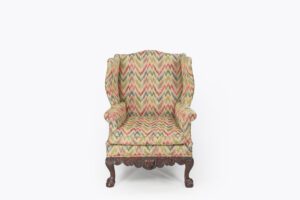
11051 – 18th Century Irish Wing Chair
Regency style (1795-1837 approximately) is characterised by its strong use of classical motifs. Initially favouring a more streamlined style of ornamentation, as exemplified by the shift away from the curving cabriole leg to the sabre leg. Chair backs and arms increasingly borrowed the lyre motif from the ancient klismos chair. Gillows of Lancaster and London produced very fine examples in this style. The two pairs of Regency chairs picture below typify the restrained elegance that differentiates Regency seating from early Georgian examples.
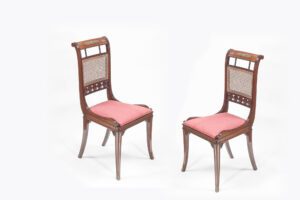
11522 -19th Century pair of James Shoolbred & Co chairs.
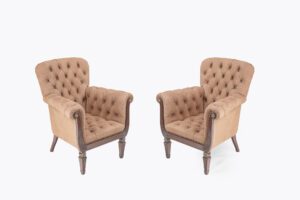
10753 – Pair of Early 19th Century Regency ‘Lyre’ Fronted Library Armchairs
The tension between function and expression is one of the elements that makes collecting and displaying different styles of chairs so rewarding. Every chair performs the same modest function, of course. Yet much is revealed about generational differences and aspirations when you look at the variety of styles of chairs throughout history. A Chippendale carver, a lion-masked Irish wingchair, and a Gillows lyre-back each represent a different decade of the same broad era, yet each carries the unmistakable mark of its own moment. Nearly three centuries later, all three are still doing the job they were made for and doing it in style!
For any inquiries, please email us at info@osullivanantiques.com. We are always happy to hear from you.
