
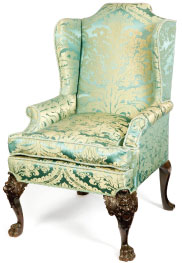
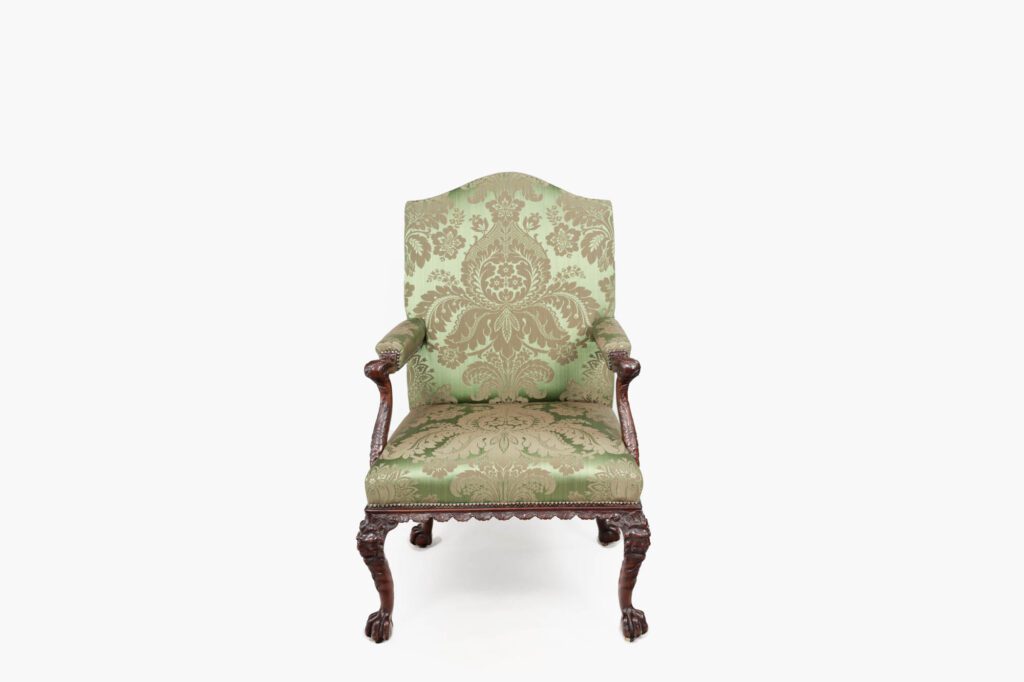
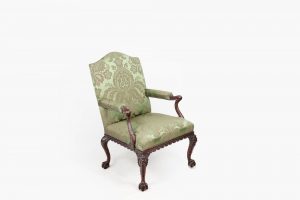
Some pieces of furniture are functional. Others are statements. And then there are those rare objects that manage to be both — pieces that were made to be sat in, and yet are so thoroughly thought through, so assured in their design and execution, that they tell you everything about the time and culture that produced them. This George III carved mahogany Gainsborough armchair, dating to around 1760, is just that.
The Gainsborough armchair is one of the most recognisable forms in English furniture. Wide, deep, high-backed, with open sides and short upholstered arms, it was designed for comfort in a period when comfort (for those who could afford it) had become an art form. The name comes from the painter Thomas Gainsborough (1727–1788), in whose portraits of English aristocracy chairs of exactly this type appear again and again either positioned to convey ease, status, and a certain studied informality.
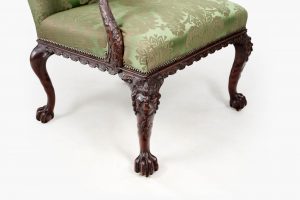
What lifts this example is the quality and ambition of its carving. The arms are shaped and scrolled, with leaf-carved mouldings running along their supports and into the apron. The front legs are cabriole, carrying the eye from seat rail to floor without a straight line in sight, terminating in lion paw feet of considerable presence.
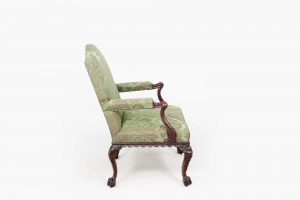
But the detail that marks this chair as exceptional is the lion mask carved into each front leg. This was not a common feature. It demanded a carver who could render a convincing face in mahogany at small scale, with the grain of the wood working against you. Thomas Chippendale, whose Gentleman and Cabinet-Maker’s Director of 1754 defined the taste of this precise moment, was himself a keen advocate of the lion paw foot. The lion mask takes that sensibility a step further, turning a structural element into a miniature sculpture.
Circa 1760 places this chair at a remarkable moment in English furniture history. George III had just come to the throne. Chippendale’s Director was six years old and had transformed what English craftsmen thought possible in mahogany. The material itself – rich, dark, strong – had been the dominant choice of London’s best workshops for thirty years.
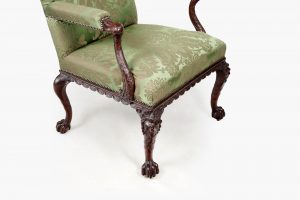
The floral carvings on the chair complement the lion motifs. This balance of the vigorous and the delicate was characteristic of mid-Georgian work. By this point English furniture makers had absorbed the exuberance of the Rococo without being overwhelmed by it. The result was a style that was confident, inventive, and deeply skilled.
Please feel welcome to browse our website for similar pieces. If you are interested in this piece or have any questions, please inquire via our email info@osullivanantiques.com, and ask for stock number 10861.
