
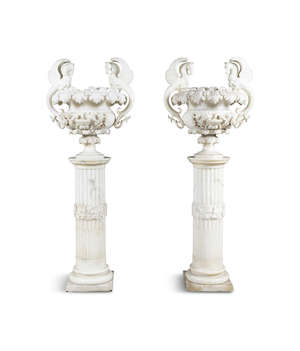
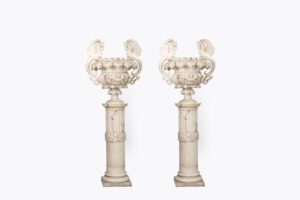
There is something immediately arresting about a piece carved in alabaster. Unlike the cool grey authority of marble, alabaster holds warmth; a soft, luminous quality that seems almost lit from within. This pair of 19th century carved alabaster jardinières on stands is exactly that kind of find; and it sits alongside another exceptional set of alabaster urns.
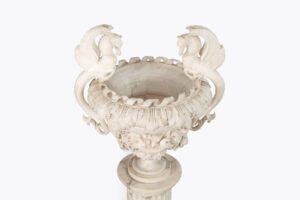
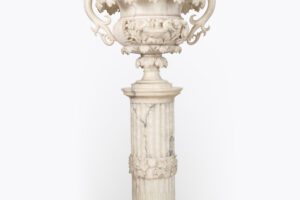
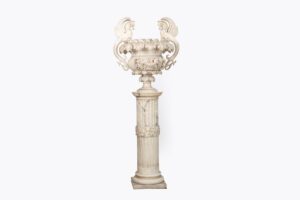
Each jardinière consists of a carved alabaster pot that is deeply worked with foliate decoration, fitted with winged horse handles, and mounted on a fluted classical column rising from a square plinth base.
A jardinière (from the French, meaning simply a stand for flowers or plants) was one of the defining decorative objects of the Victorian interior. As wealthy households filled their drawing rooms and entrance halls with exotic plants (palms, ferns, orchids), the vessel displaying them became as important as the plant itself. A well-appointed jardinière on a matching stand was a statement of culture and refinement.
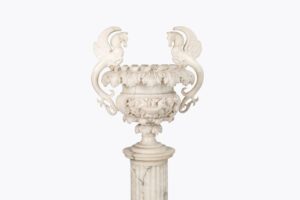
What distinguishes these particular pieces is their mythological carving. The winged horse (Pegasus, a symbol of inspiration and nobility) appears as handles on the jardinières, while the urns feature winged hippocampi – the half-horse, half-fish creatures of ancient Greek legend. Both motifs were favourites of Neoclassical designers, and their appearance here gives each piece a sculptural character beyond the purely decorative. The urns also carry bas-relief panels depicting the Doves of Pliny, an ancient Roman mosaic subject that became one of the touchstones of 19th century decorative art.
Alabaster is a fine-grained form of gypsum, quarried and worked predominantly in Tuscany, most famously in and around Volterra, a hilltop town whose workshops supplied the European market with carved alabaster objects for centuries. Softer and more workable than marble, it allows for crisp, detailed carving that marble would resist, and its natural translucency means that thin sections glow when light catches them.
In the 18th and 19th century, large alabaster urns and vases were prized not only by European royalty but by the owners of great houses in Britain and Ireland who used them to enhance the architectural interest of spaces in palaces and grand homes. By the 19th Century, British and Irish aristocrats on the Grand Tour (i.e., the traditional educational journey through France, Italy and beyond) returned home with alabaster pieces as luxury souvenirs. In a contemporary home, pieces like these do exactly that: they anchor a space and give it a sense of history.
Please feel free to browse through our website to see some of our fine pieces in both our Dublin and New York Galleries. If you have any questions about this piece or are interested, please feel free to reach out to us via our email info@osullivanantiques.com.
